Peridot holds the August birthstone slot, and it earns a distinction almost no other gem can claim: it does not form where most gems form. Sapphire, garnet, tourmaline, and beryl crystallize in the Earth’s crust. Peridot crystallizes in the mantle, tens of miles down, and typically reaches the surface when a volcano carries it up. A smaller amount never formed on Earth at all. It arrived inside meteorites that predate the planet. For rockhounds, meteorite collectors, and gem show regulars, that origin story makes peridot one of the most interesting stones on any dealer’s table in August or any other month.
A Gem Colored by Its Own Recipe
Peridot is the gem variety of olivine, a magnesium iron silicate that sits among the most abundant minerals in the upper mantle. The green comes from iron, and that detail separates peridot from most colored stones. Ruby is red because trace chromium contaminates otherwise colorless corundum. Emerald is green for the same borrowed reason. Peridot needs no contaminant: iron is part of the mineral’s own formula, so every peridot is green by definition. Gemologists call this an idiochromatic gem, colored by its own chemistry rather than by impurities.
The proportion of iron controls the shade. Lower iron content typically produces the pure grass green that collectors pay for, while higher iron pushes the color toward yellowish and brownish olive. Because the color is built into the crystal, peridot cannot be a different color, and it is not typically subjected to the heat and irradiation treatments that complicate buying in other gem categories. A faceted peridot on a show table is, with rare exceptions, exactly what it grew as. For buyers tired of asking about treatment disclosure, that simplicity has real appeal.
Delivered by Volcano
Most peridot forms in peridotite, the olivine-rich rock of the upper mantle. It reaches collectors through basaltic volcanism: rising magma tears off chunks of mantle rock and carries them to the surface as xenoliths, the geologic term for foreign rock fragments embedded in lava. Break open the right basalt flow and the green crystals are sitting inside.
Peridot Mesa on the San Carlos Apache Reservation in Arizona illustrates the process. The mesa is a basalt flow loaded with mantle xenoliths, and mining there, done by hand by members of the San Carlos Apache Tribe, has supplied much of the world’s commercial peridot for decades. Arizona stones tend to be small, which is why fine peridot above a few carats typically comes from elsewhere: the Sapat Valley in Pakistan has produced large, saturated crystals since the 1990s, and Myanmar’s Mogok region contributes fine material as well. Olivine also weathers out of basalt into sand, which is what makes the green sand of Hawaii’s Papakolea Beach green, though those grains are generally too small and too fractured to cut.
The volcanic delivery route matters to field collectors because it defines where to look: peridot country is basalt country. It also explains the crystals’ condition. Olivine that survives a ride in magma often arrives strained and included, which is why clean faceted peridot in larger sizes commands the prices it does.
Delivered by Meteorite
The stranger delivery route is from space. Pallasites, one of the rarest meteorite classes, consist of olivine crystals suspended in an iron-nickel matrix. A polished pallasite slice, metal gleaming around translucent green and amber crystals, is among the most visually striking objects in the meteorite trade, and slices from famous falls such as Esquel, Imilac, and Fukang circulate steadily at larger shows. These stones are thought to have formed at the core-mantle boundary of asteroids that broke apart early in the solar system’s history, making the olivine inside them older than the Earth itself.
A small fraction of pallasitic olivine is clean enough to facet, and cut extraterrestrial peridot does exist. The stones are typically well under a carat, often fractured, and priced as curiosities rather than as jewelry gems. Collectors considering one generally look for documentation tying the material to a classified meteorite, since a faceted green stone carries no visible proof of its origin. Olivine’s reach extends beyond meteorites: NASA’s Stardust mission returned olivine particles from comet Wild 2 in 2006, confirming the August birthstone’s mineral family as common material in comets as well.
For a collector, this means the same species can show up in multiple forms on one shelf: a terrestrial crystal in its basalt matrix, a slice of a pallasite meteorite, and a faceted gem cut from either source. Few minerals support that range, and few other birthstones offer as many collecting options, a spread worth seeing firsthand at a show like Hart Gem Shows’ Denver event.
The Stone Mistaken for Emerald
Peridot’s documented history starts on Zabargad, a small island in the Red Sea also known as St. John’s Island, where Egyptians mined the stone for millennia. Ancient sources describe it as the gem of the sun, and the island’s peridot moved through Egyptian, Greek, and Roman hands long before modern gemology existed. Because antiquity had no reliable way to separate green stones, historians consider it plausible that some gems recorded as emeralds, including stones in the legendary collection of Cleopatra, were actually Zabargad peridot. Some large “emeralds” in European church treasuries have since been identified as peridot. The island’s deposits are no longer commercially mined, which has turned documented Zabargad material into a locality collectible in its own right.
Reading Peridot on the Show Floor
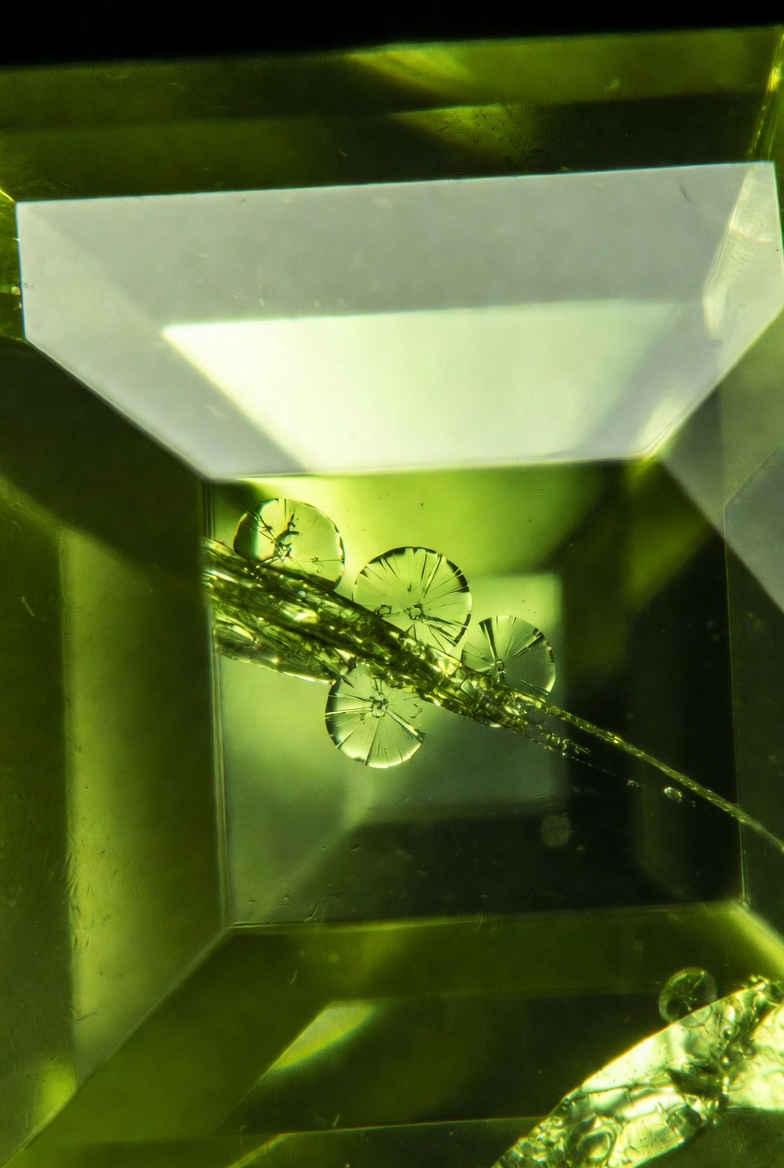
Peridot rewards a loupe. The stone’s birefringence is high enough that a buyer looking through the table of a faceted peridot can often see doubling of the back facet edges, an effect glass imitations and most look-alike gems do not show. Classic inclusions help too: “lily pad” inclusions, tiny disc-shaped fractures surrounding a minute crystal, are a well-known peridot signature. Neither observation replaces lab work for an expensive stone, but both give show buyers a fast, free plausibility check at the table.
Durability deserves honest treatment. Peridot measures 6.5 to 7 on the Mohs scale, softer than the quartz found in ordinary household dust, which sits at Mohs 7 and can scratch it, and it is sensitive to acids and to thermal shock. It wears fine in pendants and earrings, and it asks for more care in a daily ring. Dealers who say so plainly are the kind worth returning to.
August technically offers alternatives, catalogued alongside peridot in Hart Gem Shows’ guide to summer gemstones: sardonyx is the month’s traditional stone, and Jewelers of America and the American Gem Trade Association added spinel as a third option in 2016. Both reward collecting. Neither matches peridot’s core claim, and that claim is worth restating plainly: this is a birthstone delivered by volcanoes, carried in meteorites, found in comet dust, and thought to have been worn by pharaohs, all while remaining affordable enough that a show attendee can leave with a good one for less than the cost of the trip. Handling a few parcels side by side, from Arizona, Pakistan, and Myanmar if the tables allow, remains the fastest way to learn what separates commercial green from the color that stops people in the aisle.